Nine tools that put feedback inside an iOS app, grouped by the kind of feedback they collect: feature votes, chat, bug reports and surveys. Plus the question most lists skip: is the SDK native, or a web page inside a web view?
By Martin Lasek · Oct 6, 2026 · 10 min read
Most lists of in-app feedback tools are written for websites. They rank survey widgets and session recorders, and they rarely say whether a tool works inside an iPhone app at all. This one is only about iOS. Every tool here can collect feedback inside an iOS app, and each section says how: with a native SDK, or with a web page shown in a web view.
Prices come from each vendor's own website, checked on October 6, 2026. WishKit is our product and is listed first, with the same facts and the same pick it if and skip it if as the rest.
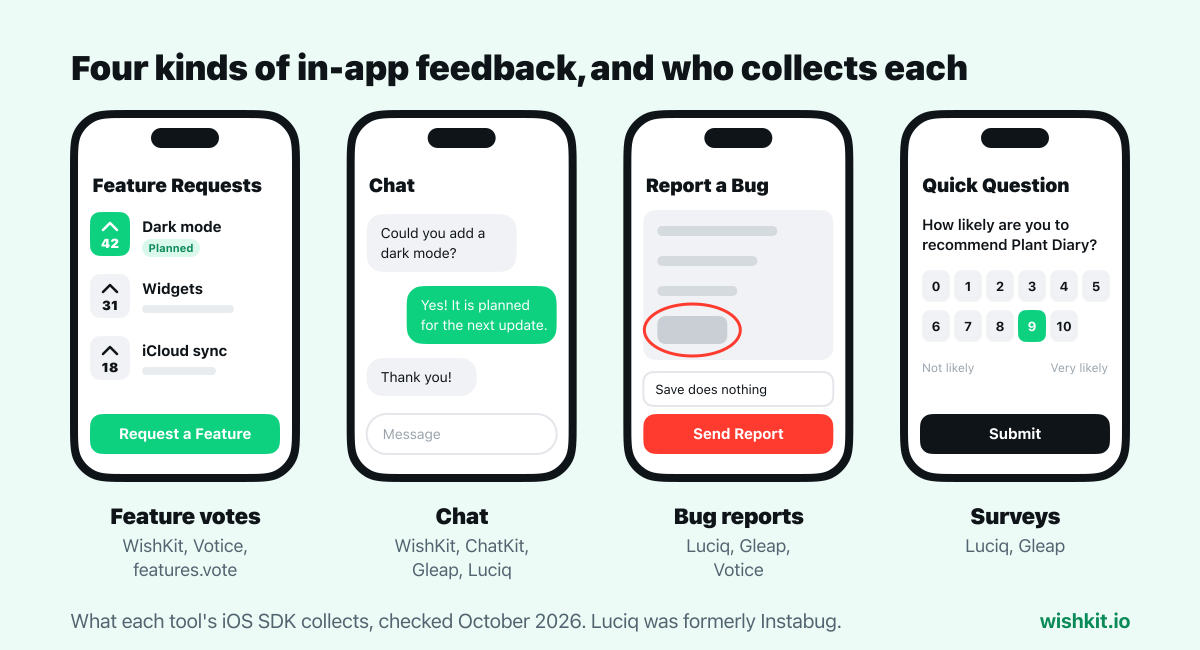
An in-app feedback tool is an SDK that lets people tell you something without leaving your app: a feature they want, a bug they hit, a question, or an answer to a survey. Users skip the trip to email or the App Store. You get the message with context, such as who sent it and from which version, in one dashboard. The tools differ mainly in which of those four kinds of feedback they collect.
| Tool | Collects | On iOS | Free plan | Entry paid plan |
|---|---|---|---|---|
| WishKit | Feature votes, chat | SwiftUI SDK | Yes, 1 project | $15/mo ($12.50 yearly) |
| Votice | Feature votes, bug reports | SwiftUI SDK | Yes, 1 app | $3.99/mo ($44.99 a year) |
| features.vote | Feature votes, roadmap, changelog | SwiftUI SDK | No, 14-day trial | $9/mo ($7.50 yearly) |
| ChatKit | Chat | Swift package | Free to start | Not published |
| Luciq (Instabug) | Bug reports, crashes, surveys, replies | Closed-source SDK | No | Custom, yearly deal |
| Gleap | Bug reports, chat, surveys, roadmap | SDK with a web view | Yes, chat and bug reports | $179/mo ($149 yearly) |
| Canny | Feature votes, roadmap, changelog | Web widget in a web view | Yes, 25 tracked users | $99/mo ($79 yearly) |
| Featurebase | Feature votes, roadmap, changelog | Web view | Yes, 1 seat | $37 per seat ($29 yearly) |
| UserJot | Feature votes, roadmap, changelog | Beta SDK with a web view | Yes, 2 boards | $29/mo |
Based on each vendor's website, documentation and SDK source as of October 2026. Spotted something outdated? Let us know.
This is the difference you feel first. A native SDK draws its screens with SwiftUI or UIKit, so it uses the system font, follows dark mode and Dynamic Type, and navigates like the rest of your app. A web view loads a web page inside your app: it shows a spinner while the page loads, it looks like a website because it is one, and some users read it as leaving the app.
Two checks settle it before you commit. Open the SDK's source and search for WKWebView, which is how the Gleap and UserJot sections below were checked. And read the install guide: when it asks you to create a web view with a URL, there is no native screen.
WishKit puts a feature request board and a private 1-on-1 chat inside your app, both drawn in SwiftUI on iOS, macOS, visionOS, watchOS and tvOS. Users post requests, vote and comment without creating an account, and the SDK ships translated into 17 languages. If your app knows a user's email or what they pay, one call attaches it, so you can sort requests by revenue and email voters when their request ships. The same dashboard answers your App Store reviews, and the board embeds on your website too. Free covers one project with unlimited users and shows the first five requests. Premium is $15 a month flat ($12.50 billed yearly). WishKit does not collect bug reports with screenshots, crash logs or survey answers, so pair it with a bug tool if you need those.
More: in-app feature voting on iOS compares five ways to add voting, and the SwiftUI tutorial walks through the setup.
A young SwiftUI SDK from an independent developer in Spain, released in 2025. Users post suggestions or report issues with an optional image, then vote and comment. You manage it all in Votice's own app on iPhone, iPad or Mac rather than in a web dashboard. It runs on iOS 17, macOS 14 and tvOS 17 or later, ships in English with a protocol for your own texts, and identifies users by an anonymous device ID. Free covers one app. Pro costs $3.99 a month or $44.99 a year in the US App Store, and a lifetime license is $89.99. Pro can also turn feedback into GitHub issues.
More: WishKit vs Votice.
A web voting board that added a Swift SDK in January 2026. Its SwiftUI views cover voting, a roadmap and a changelog on iOS, iPadOS and macOS, and the README promises "Zero external dependencies." Voting works without signup, which features.vote calls "zero-signup voting". Lite costs $9 a month ($7.50 billed yearly) for one project, Growth $29 ($24.16) for unlimited projects. There is no free plan, only a 14-day trial.
More: WishKit vs features.vote, features.vote pricing.
ChatKit does one thing: a private conversation between each user and you. You add the Swift package, place its view inside a NavigationStack, and messages arrive in a web inbox. Its own pitch is "Two lines of Swift, no servers, free to start." It is iOS only, and paid prices are not published. A chat is the friendliest channel for questions and ideas that need a reply, but it does not rank anything. Ten people asking for dark mode are ten separate threads. That is why WishKit added the same kind of chat next to its board, covered in how to add in-app chat to an iOS app.
More: WishKit vs ChatKit, ChatKit alternatives.
For years the default bug reporter on iOS. Instabug renamed itself Luciq in September 2025 and now sells agentic mobile observability. The SDK still works the way iOS developers remember: "By default, Luciq is shown when the device is shaken." Users can annotate a screenshot "by drawing on, magnifying, or blurring specific parts", and a report can carry a screen recording of "up to the last 30 seconds before a report is sent." Crash reporting, performance monitoring, session replay, in-app surveys and replies inside the app come with it, on iOS, Android, React Native, Flutter and Kotlin Multiplatform. Its docs still describe a feature request board with voting, under the Instabug name. Luciq says 25,000+ mobile teams rely on it. What changed with the name is how you buy it:
"Luciq has officially deprecated its self-serve pricing plans."
There are no public prices. The pricing page offers one plan "priced on DAU and Seats", and the docs describe an annual commitment, arranged after a demo.
More: WishKit vs Instabug (Luciq).
An AI support suite whose iOS SDK collects bug reports with screenshots, live chat, surveys and roadmap ideas from one widget. That widget is a web view: the open-source iOS SDK loads Gleap's hosted messenger in a WKWebView. Gleap now has a Free plan with one seat and one project, live chat and in-app bug reporting for up to 50 tickets a month. Surveys and the roadmap start on Team, which costs $149 a month billed yearly or $179 monthly, and its AI agent adds $0.29 for every conversation it resolves.
More: WishKit vs Gleap.
These three are web products first. On iOS you show their board in a WKWebView or hand the user off to Safari. That is a fine choice when the same board already serves your website.
Canny has no iOS SDK. Its help center suggests the web widget instead: "You can also use a Canny widget inside a mobile app." You get Canny's mature boards, roadmap and integrations, priced by tracked users. Free covers 25 tracked users, and Pro starts at $99 a month ($79 billed yearly) for 100, rising with every tier after that.
More: WishKit vs Canny, Canny pricing.
Featurebase's mobile route is a web view too. Its help center has you generate a URL, "Then, proceed to create a WebView with that URL." Its Messenger installs with a JavaScript SDK, and Featurebase's own iPhone app is an inbox for your support team, not an SDK for your users. Free covers one seat, and paid plans cost $29 per seat a month billed yearly, or $37 monthly.
More: WishKit vs Featurebase, Featurebase pricing.
The only web board here with a Swift package of its own. Its README says "This SDK is currently in beta (v0.3.0)", and the package shows UserJot's web board in a WKWebView. The free plan is generous, with two boards, three admins and unlimited users, and paid plans start at $29 a month.
More: WishKit vs UserJot, UserJot pricing.
Before any SDK, iOS has three feedback channels built in. Each covers a gap, and none replaces the tools above.
Apple's Feedback Assistant app is the one that sounds right and isn't. It sends feedback to Apple, not to you.
The tool matters less than where its entry point sits. Five placements that work in iOS apps:
If all you need today is an in-app feedback form, a text field and a send button are enough to start. The fields worth adding, and the replies to send afterwards, are in the feature request template.
An SDK that lets users send feedback from inside your app: feature requests and votes, bug reports with screenshots, chat messages or survey answers. It arrives in one dashboard with context about who sent it, instead of scattered across email and reviews.
It depends on what you want to collect. For feature requests and votes with native screens, WishKit, Votice or features.vote. For bug reports and chat in one widget, Gleap. For crash reporting and monitoring at scale, Luciq, formerly Instabug.
Yes. WishKit is free for one project with unlimited users, Votice for one app, and Gleap for one seat with live chat and bug reports. Canny is free up to 25 tracked users, and UserJot's free plan has two boards, both shown in a web view.
A native SDK draws its screens with SwiftUI or UIKit, so it matches your app's fonts, dark mode and navigation. A web view shows a web page inside your app, with its own loading state and web styling. Search the SDK's source for WKWebView to find out which one you are getting.
Instabug renamed itself Luciq in September 2025, and instabug.com now redirects to luciq.ai. Self-serve plans are no longer available to new customers. Pricing is based on daily active users and seats and is arranged through a demo.
Yes, with a mail button from Apple's MessageUI framework, TestFlight feedback during the beta, and App Store reviews after launch. None of them lets users see or vote on each other's ideas, which is what an SDK adds.
Setup takes less than a minute. Free plan included, no credit card required.
Try WishKit for free