Fourteen feature request and feature voting tools, with prices checked on each vendor's own pricing page. Grouped by the one thing that decides your bill as you grow: nothing, your team, your boards or your users.
By Martin Lasek · Oct 6, 2026 · 11 min read
A feature request tool gives your users one place to suggest features, vote on each other's ideas and see what you plan to build. It replaces the scattered requests in support emails, reviews and calls with one ranked list. The tools look alike on their homepages. Where they really differ is the price two years from now, because each one grows its bill with something else.
This comparison covers fourteen tools. Prices come from each vendor's own pricing page, checked on October 5, 2026. WishKit is our product and is listed first, with the same facts and the same pick it if and skip it if as the rest.
A feature request tool, also called feature request software or a feature voting tool, is a board where users post ideas, vote on the ones they want and follow their status through a roadmap. You get a list ranked by demand instead of a pile of messages. Most add comments, a public roadmap and a way to tell voters when something ships.
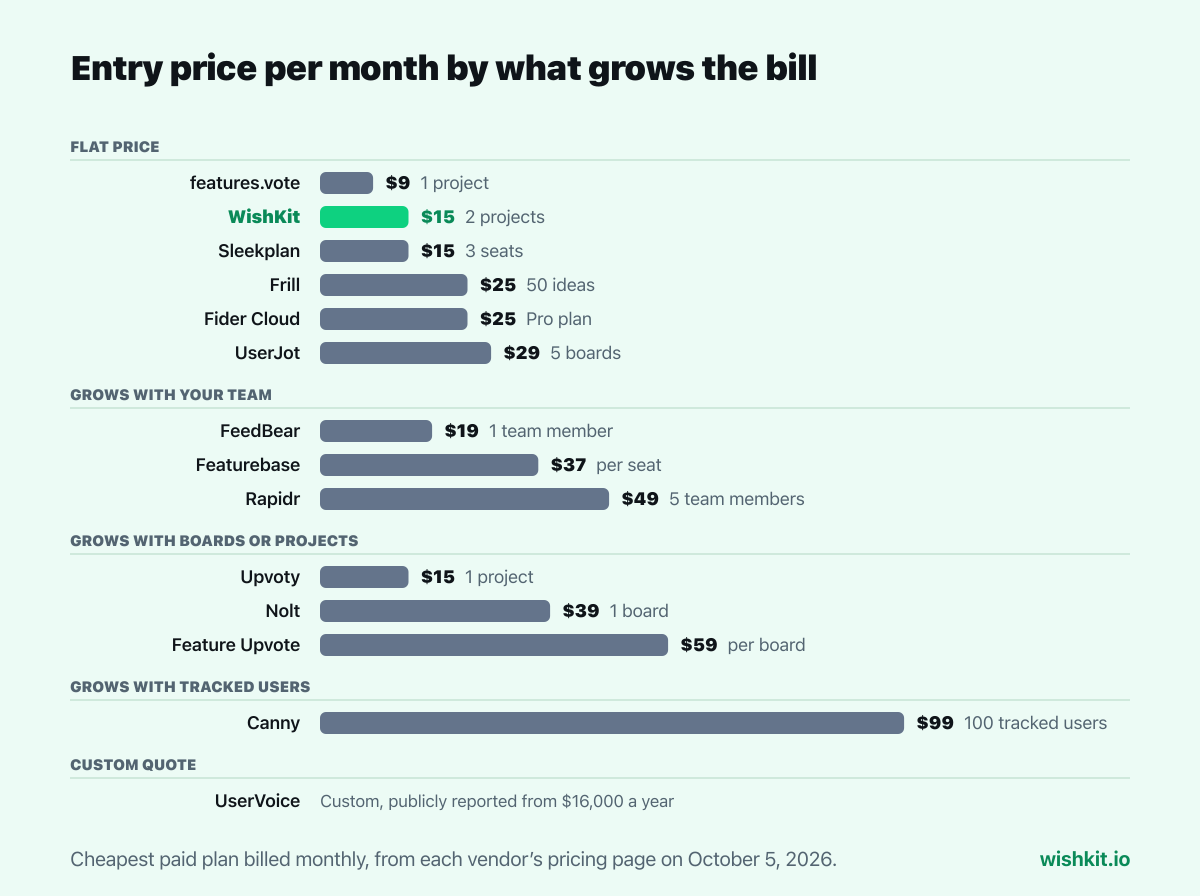
| Tool | Free plan | Entry price, monthly | Billed yearly | What grows the bill |
|---|---|---|---|---|
| WishKit | Yes, 1 project | $15 | $12.50 | Nothing, flat |
| features.vote | No | $9 | $7.50 | A second project |
| Sleekplan | Yes, single admin | $15 | $13 | Plan tier |
| Frill | No | $25 | $22 | Plan tier |
| UserJot | Yes, 2 boards | $29 | Not published | Plan tier |
| Fider | Yes, self-hosted or up to 250 requests | $25 | Not offered | Going past 250 requests |
| FeedBear | No | $19 | $15 | Team members |
| Featurebase | Yes, 1 seat | $37 per seat | $29 per seat | Seats |
| Rapidr | No | $49 | Not published | Team members |
| Upvoty | No | $15 | $13.50 | A second project |
| Nolt | No | $39 | $29 | Boards |
| Feature Upvote | No | $59 per board | $49 per board | Boards |
| Canny | Yes, 25 tracked users | $99 | $79 | Tracked users |
| UserVoice | No | Custom | Reportedly from $16,000 a year | Volume, tools, integrations |
Based on publicly available pricing as of October 2026. Spotted something outdated? Let us know.
WishKit is a feature request board with voting, comments and a public roadmap, built for apps first: a native SwiftUI SDK for iOS and a two-line embed for websites. The price is flat. Premium costs $15 a month ($12.50 billed yearly) with two projects, Enterprise $39 with unlimited projects, and neither counts users, voters or seats. The free plan covers one project and shows the first five requests, storing the rest until you upgrade. Premium adds user comments, 1-on-1 chat with users, capturing requests from posts on X and an email to voters when a request ships. For iOS apps, the WishKit iOS SDK puts the board one tap away inside the app.
The cheapest paid board on this list. Lite costs $9 a month ($7.50 billed yearly) for one project, Growth $29 ($24.16) for unlimited projects, a changelog, private boards and a custom domain. Their pricing page puts it simply: "Pricing never scales with votes, voters or tracked users." It now ships a native SwiftUI SDK as well, with voting, roadmap and changelog views for iOS, iPadOS and macOS. No free plan, a 14-day trial.
More: WishKit vs features.vote, features.vote alternatives.
An all-in-one widget for websites: a feedback board and changelog, plus a roadmap, NPS and CSAT surveys on paid plans. "Pricing is per workspace." The free Indie plan is a single-admin workspace without the roadmap. Starter costs $15 a month ($13 billed yearly) with three team seats, Business $45 ($38) with ten seats, branding removal and a custom domain. Paid plans come with a 30-day trial.
More: WishKit vs Sleekplan, Sleekplan alternatives, Sleekplan pricing.
A polished board with ideas, a roadmap and announcements, and unlimited teammates and tracked users on every plan. "Frill pricing is plan-based, not seat-based." Startup costs $25 a month ($22 billed yearly) and is capped at 50 ideas, Business $49 ($44) removes the cap, Growth $149 ($136) includes privacy, surveys and white labeling, Enterprise $349 ($319). 14-day trial.
More: WishKit vs Frill, Frill alternatives, Frill pricing.
A modern web board with the most generous free plan here: unlimited posts and users, two boards and three admins. Starter costs $29 a month with five boards, a custom domain and private boards, Professional $59 with unlimited boards, single sign-on and branding removal. No yearly price is published. Their line: "Pay for features, not seats." 14-day trial on paid plans.
More: WishKit vs UserJot, UserJot alternatives, UserJot pricing.
The open-source option, licensed under AGPL-3.0. You can run it on your own server for free, or use the hosted version: free up to a fair-use limit of 250 feedback requests, then Pro at $25 a month, billed month to month. We don't keep a comparison page for Fider on purpose. People who want to self-host have usually made up their mind already.
A simple board with a roadmap and changelog, priced by team size. Lite costs $19 a month ($15 billed yearly) for one team member and one board, Startup $49 ($40) for three members and unlimited boards, Business $99 ($82) for ten, Enterprise $299 ($249). A second project is billed separately. No free plan, a 14-day trial.
More: WishKit vs FeedBear, FeedBear alternatives, FeedBear pricing.
A support and feedback suite: boards, a roadmap, a changelog, surveys, a help center and an AI support agent. You pay per seat. Growth costs $37 per seat a month ($29 billed yearly), Professional $75 ($59), Enterprise $129 ($99). AI answers cost $0.49 per resolved conversation and branding removal is $69 a month. A team of four on Professional pays $300 a month billed monthly. The free plan has one seat and one board, and paid plans start with a 10-day trial.
More: WishKit vs Featurebase, Featurebase alternatives, Featurebase pricing.
A web feedback portal with unlimited boards, priced by team size. Startup costs $49 a month for five team members, Business $199 for fifty with single sign-on, user segmentation and the Jira, HubSpot and Zapier integrations, and Enterprise is a custom quote. End users are never billed. No yearly price, no free plan, a 14-day trial. Removing "Powered by Rapidr" takes Enterprise.
More: WishKit vs Rapidr.
A focused voting board where each plan includes one project. Power costs $15 a month ($13.50 billed yearly), Super $25 ($22.50) adds the changelog and integrations and removes the Upvoty branding, and Hyper $49 ($44.10) unlocks unlimited projects. No free plan, a 14-day trial.
More: WishKit vs Upvoty, Upvoty alternatives, Upvoty pricing.
A clean hosted board priced by the number of boards. Essential costs $39 a month ($29 billed yearly) for one board with the Slack, Discord, GitHub and Trello integrations, Pro $89 ($69) for five boards and integrations like Jira, Linear and Zapier, and Enterprise is custom with unlimited boards. Users, content and admins are unlimited on every plan. No free plan, a 10-day trial of Pro.
More: WishKit vs Nolt, Nolt alternatives, Nolt pricing.
A deliberately simple board, and the most direct about its price: "Our price is per feedback board." Indie costs $59 per board a month ($49 billed yearly), and Standard $119 ($99) adds custom CSS, integrations, single sign-on and removes the branding. Team members are unlimited on every board. No free plan, but the trial runs 30 days.
More: WishKit vs Feature Upvote.
The best-known tool here, with the deepest integrations (Jira, Linear, Salesforce, Intercom, Zendesk) and AI features. The bill follows your tracked users, and Canny defines them broadly: "A tracked user is any user associated with feedback." Free covers 25. Pro starts at $99 a month ($79 billed yearly) for 100 tracked users and reaches $661 a month ($529 billed yearly) at 1,000. Business is a custom quote. Go over a limit and Canny moves you up a tier unless you set a spend limit.
More: WishKit vs Canny, Canny alternatives, Canny pricing.
The enterprise veteran, with research workflows and analytics. It publishes no prices, only this: "Your plan is based on feedback volume, tools leveraged and the integrations you connect, never by seat." Publicly reported quotes start around $16,000 a year on annual contracts. A 30-day trial comes through a demo.
More: WishKit vs UserVoice, UserVoice alternatives, UserVoice pricing.
Six of the fourteen have a free option, and each draws the line somewhere else:
Asking people to create an account before they can vote loses most of the votes. WishKit doesn't ask. On iOS and on the web, the SDK gives each device or browser a random ID, and that ID gets one vote per request. People can leave an email if they want to hear back, and your app can attach a name, email or customer ID with WishKit.updateUser or WishKit.identify. features.vote advertises the same idea as "zero-signup voting".
The trade-off is worth knowing. Someone who clears their browser data gets a new ID and could vote again. Read anonymous votes as a strong signal of demand, not as an election, and identify signed-in users where you can.
Software that collects feature ideas from your users in one place, lets them vote on each other's requests and shows the status on a roadmap. It turns scattered messages into a list ranked by demand.
It depends on what makes your bill grow. For iOS apps, WishKit or features.vote with their native SwiftUI SDKs. For the lowest price, features.vote at $9 a month. For integrations, Canny. For a support suite, Featurebase. For enterprise procurement, UserVoice.
UserJot has the most generous free plan for websites (two boards, three admins, unlimited users). Fider is free if you host it yourself. Canny is free up to 25 tracked users, and WishKit is free for one project with unlimited users.
From free plans to $9 a month for the cheapest paid board (features.vote), $15 for WishKit Premium, $99 a month for Canny at 100 tracked users, and custom contracts reported from $16,000 a year for UserVoice.
WishKit and features.vote both ship a native SwiftUI SDK. With other tools, check whether the iOS option is a native view or a web page shown inside the app.
Yes. WishKit identifies each device or browser with a random ID, so people can post and vote without signing up, and email is optional. features.vote also offers voting without signup.
Yes, Fider. It is licensed under AGPL-3.0 and free to self-host. Its hosted version is free up to 250 feedback requests and costs $25 a month after that.
Setup takes less than a minute. Free plan included, no credit card required.
Try WishKit for free