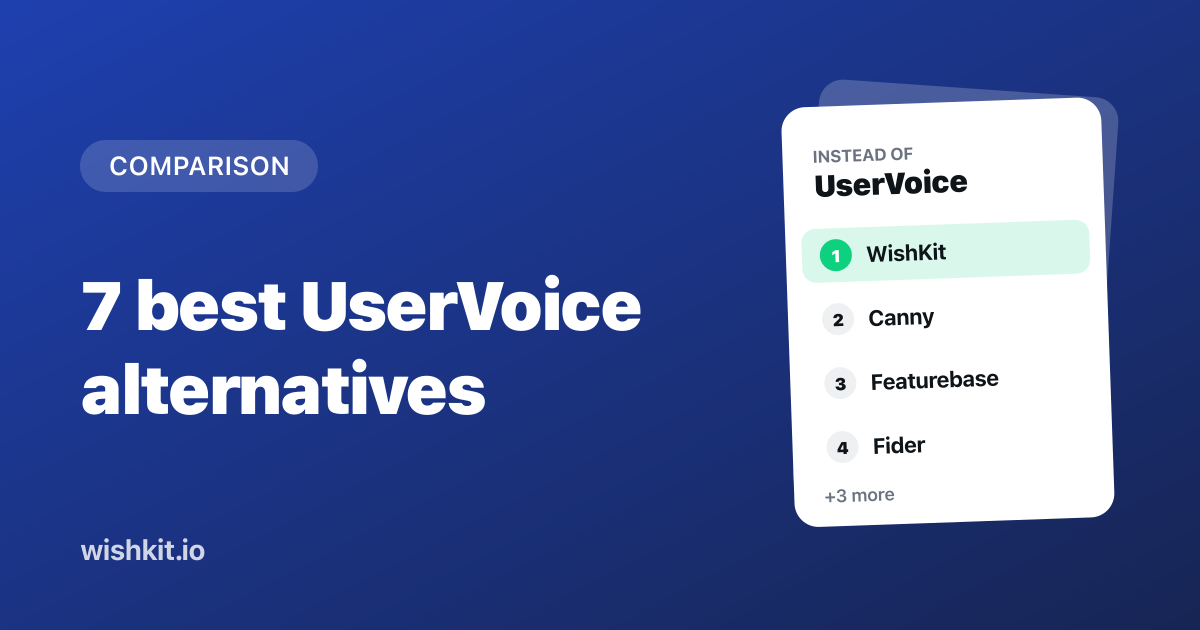
UserVoice pioneered the category, but today it is an enterprise product with enterprise pricing. These seven alternatives cover everyone else, including free and open-source options.
By Martin Lasek · Aug 13, 2026 · Updated Sep 3, 2026 · 9 min read
UserVoice more or less invented the feedback board back in 2008. So why do so many teams search for an alternative? Three reasons dominate.
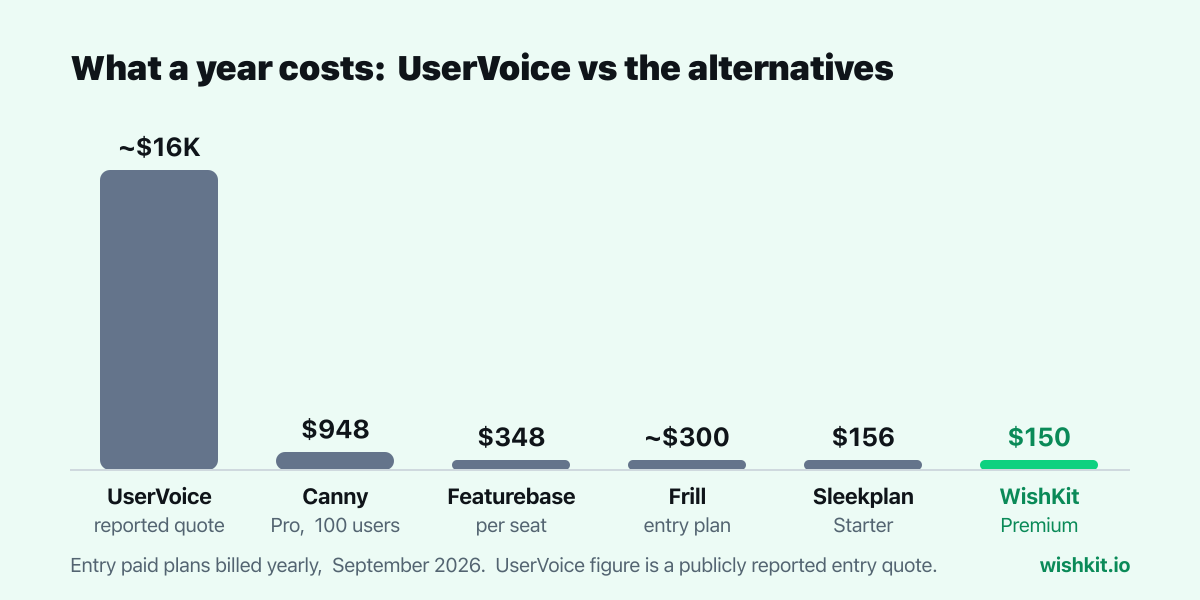
The price of entry. UserVoice no longer publishes pricing at all. Quotes are custom, reportedly starting around $16,000 a year, and legacy tiers ran $699 to $1,499 a month. There is no free plan, only a 30-day trial. We broke it down in UserVoice pricing explained.
The sales process. You cannot swipe a card and start. Getting a number means booking a call, and that alone disqualifies it for any team that wants to start today.
The weight. Research workflows, advanced analytics, account management. Valuable for enterprises, overkill if you want users to post ideas and vote.
Here are the seven alternatives worth your shortlist, including the free and open-source routes.
Full disclosure: WishKit is our product. It is also the opposite of UserVoice in almost every way: self-serve, free to start, and set up in about 100 seconds.
WishKit gives you a feedback board with voting, comments, statuses, and duplicate merging. iOS, macOS, visionOS, watchOS and tvOS apps get a native SwiftUI SDK, websites embed the same board with two lines of HTML, and WishKit can even capture feature requests from posts on X.
See the detailed WishKit vs UserVoice comparison.
Canny is the most established alternative and the natural landing spot for teams leaving UserVoice who still want depth: mature Jira, Salesforce, and Intercom integrations plus AI-powered deduplication. We compared the two head to head in Canny vs UserVoice.
Featurebase bundles feedback boards, roadmaps, changelogs, surveys, a help center, and an AI support inbox. If UserVoice appealed to you as a customer-communication hub, this is the modern version of that idea.
If you searched for a UserVoice clone you can run yourself, Fider is it. It is an open-source feedback board written in Go: users post ideas, vote, and follow status updates, and you host it with Docker and a PostgreSQL database.
Sleekplan packs a feedback board, roadmap, changelog, and NPS surveys into one website widget at an indie-friendly price.
Frill is a well-designed feedback board with ideas, roadmap, and announcements, praised for its UI and unlimited admins on paid tiers.
UserJot is a modern web feedback board with a genuinely useful free plan: two boards, unlimited posts and voters, a public roadmap, and an AI changelog.
"Free" means something different at every vendor, so here is the honest version. Hosted free plans cap something, usually projects, boards, or admin seats. Self-hosted tools cap nothing but cost your time.
Not on the free list: UserVoice itself, Frill, Upvoty, and Nolt, which all offer trials only.
If you searched for a UserVoice clone, this is the section for you. Three projects come up, and only two of them should be on a shortlist in 2026.
The trade-off is the same for all of them: full data ownership and zero license cost, against hosting, backups, updates, and no native mobile SDK. If your team already runs infrastructure, that is a fair deal. If not, a hosted free plan gets you the same board in minutes.
| Tool | Free option | Entry paid price | Best for |
|---|---|---|---|
| WishKit | $15/mo flat | Apps & SaaS, focused boards | |
| Canny | $79/mo (annual) | Deep integrations | |
| Featurebase | $29/seat/mo | Support + feedback in one | |
| Fider | Free (self-hosted) | Open source, data ownership | |
| Sleekplan | ~$13/mo | All-in-one on a budget | |
| Frill | ~$25/mo | Clean, simple boards | |
| UserJot | $29/mo | Generous free web tier | |
| UserVoice | Custom, ~$16K/yr reported | Enterprise research teams |
Based on publicly available pricing as of August 2026. Spotted something outdated? Let us know.
Yes, several. WishKit, Canny, Featurebase, Sleekplan, and UserJot all offer free plans, and Fider is free if you self-host it. For most teams the practical free pick is a hosted free plan rather than running your own server.
Fider is the established one: a self-hosted feedback board with voting and statuses. LogChimp is a smaller, actively developed Node.js option. Astuto, once popular, was archived in February 2026. Expect to bring your own hosting, backups, and updates with any of them.
There is no public price list. Quotes are custom and reportedly start around $16,000 per year, with legacy plans between $699 and $1,499 per month. The full picture is in UserVoice pricing explained.
Setup takes less than a minute. Free plan included, no credit card required.
Try WishKit for free