Four numbers per idea, one division, and a ranked list. Here is how Intercom's RICE framework scores feature requests, where it misleads, and a calculator to try it on your own list.
By Martin Lasek · Oct 5, 2026 · 9 min read
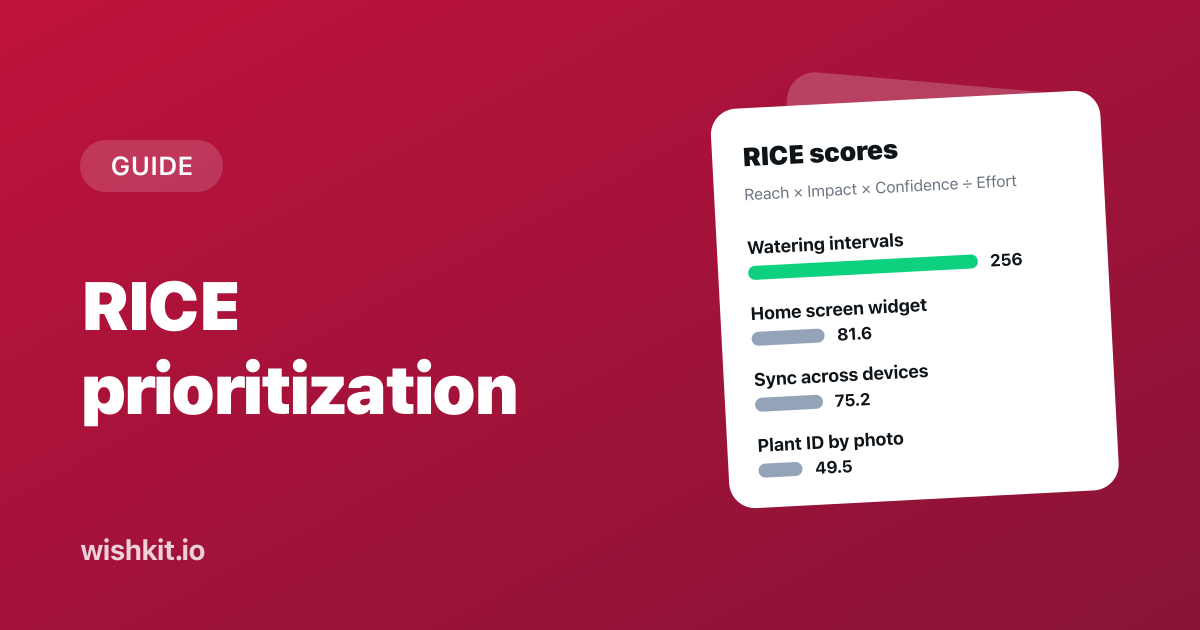
RICE prioritization gives every feature idea a single number, so a long list of requests turns into a ranked one. The RICE score multiplies how many people an idea reaches, how much it helps each of them and how sure you are, then divides by the effort. People search for it as the RICE framework, RICE scoring or the RICE model. It's all the same formula.
This guide takes the scales from the article that introduced RICE, scores five feature requests from one app, shows where the number misleads, and ends with a calculator you can use on your own list. Plant Diary is a made-up app for the examples, the same one as in the MoSCoW guide.
RICE score = (Reach × Impact × Confidence) ÷ Effort. Reach is how many people the feature affects in a fixed period, Impact is 3, 2, 1, 0.5 or 0.25, Confidence is 100%, 80% or 50%, and Effort is in person-months. Build the highest score first, unless a dependency or a commitment says otherwise.
RICE was introduced by Intercom's product team in an article by Sean McBride, published on January 5, 2018. They wanted a way to compare very different ideas consistently, and in their words "we began developing our own scoring system for prioritization from first principles." The four letters are the four factors.
How many people will this affect? Intercom's instruction is to "estimate how many people each project will affect within a given period", for example customers per quarter. The period matters: every request on one list needs the same one, or the scores aren't comparable.
How much will it help each of those people? Impact can't be measured precisely before you build, so Intercom uses fixed steps:
"So, I choose from a multiple-choice scale: 3 for “massive impact”, 2 for “high”, 1 for “medium”, 0.5 for “low”, and finally 0.25 for “minimal”."
How sure are you about the other three numbers? Confidence is the factor that keeps exciting but vague ideas honest:
"100% is “high confidence”, 80% is “medium”, 50% is “low”. Anything below that is “total moonshot”."
How much work is it, for everyone involved: product, design and engineering? Effort is counted in "person-months", the work one person does in a month. Intercom keeps it rough, with whole numbers and half a month as the smallest step. It is the only factor that divides, because more effort makes an idea less attractive.
Multiply Reach, Impact and Confidence, then divide by Effort. Intercom describes the result as "total impact per time worked". The absolute number means nothing on its own. It only says something next to the scores of the other ideas on the same list.
Plant Diary's feedback board has a vote count on every request. The team uses the votes from the last quarter as Reach, since the people who asked are the ones most likely to use the feature. Effort comes from the estimates in days, at 20 working days per person-month, rounded the way Intercom suggests.
| Request | Reach | Impact | Confidence | Effort | Score |
|---|---|---|---|---|---|
| Watering intervals | 64 | 2 | 100% | 0.5 | 256 |
| Home screen widget | 51 | 1 | 80% | 0.5 | 81.6 |
| Sync across devices | 47 | 2 | 80% | 1 | 75.2 |
| Plant ID by photo | 33 | 3 | 50% | 1 | 49.5 |
| Dark mode | 38 | 0.5 | 100% | 0.5 | 38 |
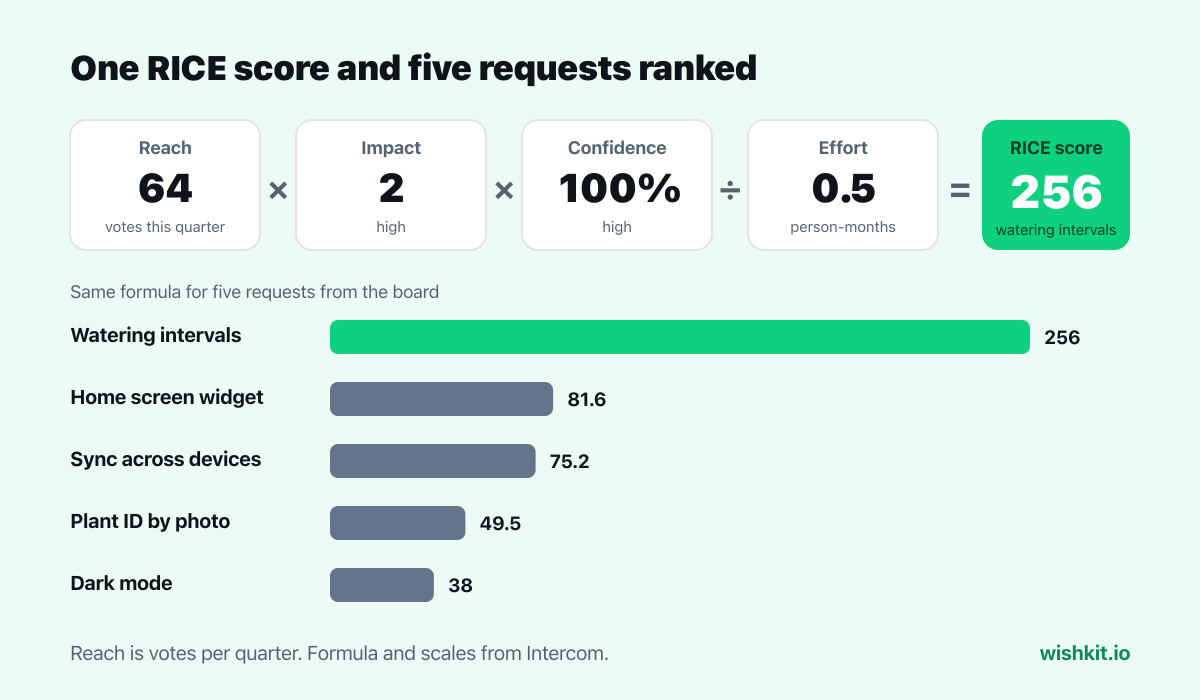
The ranking holds a surprise. In the MoSCoW example for the same release, sync is a Must, because it was announced as half of version 2.0. RICE puts it below the widget, because the formula knows nothing about promises or dependencies. Intercom says as much:
"Of course, RICE scores shouldn’t be used as a hard and fast rule."
"One project may be a dependency for another project, so it needs to happen first, or another feature might be “table stakes” to sell to certain customers."
That is the right way to use the number: as a default order you can overrule, with a reason you can say out loud. The Kano model gives one such reason, since it shows when a low-impact request like dark mode is a basic people expect.
Type your own requests into the table. Each score updates as you type, and the highest one is highlighted. Reach can be any count per period, as long as every row uses the same one. Nothing you enter leaves your browser.
| Request | Reach | Impact | Confidence | Effort | Score | |
|---|---|---|---|---|---|---|
| 256 | ||||||
| 81.6 | ||||||
| 75.2 | ||||||
| 49.5 | ||||||
| 38 |
Reach is the factor teams most often make up. A vote count on each request is a real number that comes from the people who will use the feature, it is counted the same way for every request, and it already has a period if you look at the last quarter. It undercounts people who never vote, but it undercounts them evenly, which is what a ranking needs.
A feature request board collects those votes without extra work: users post ideas and vote on each other's, and the count is there when you score. WishKit does this for websites and SaaS products, and inside iOS apps with a native SDK.
Reach, Impact, Confidence and Effort, the four numbers you estimate for every idea.
Multiply Reach by Impact and by Confidence, then divide by Effort. With a reach of 64, impact 2, confidence 100% and effort 0.5 person-months, the score is 64 × 2 × 1 ÷ 0.5 = 256.
Intercom. Sean McBride described it on Intercom's blog in an article published on January 5, 2018.
There is no absolute good score. A score only means something compared with the other scores on the same list, estimated for the same period.
RICE ranks ideas by a calculated score. MoSCoW sorts them into Must, Should, Could and Won't for a fixed release. RICE ignores commitments and dependencies, and MoSCoW ignores small differences in value, so many teams use MoSCoW for what must ship and RICE to order everything else.
Yes, as long as every request uses votes from the same period. Votes undercount people who never vote, but they do so evenly across requests, which keeps the ranking fair.
Setup takes less than a minute. Free plan included, no credit card required.
Try WishKit for free