Apple started the naming convention with UIKit and StoreKit, and the ecosystem ran with it. A field guide to the third-party *Kits worth knowing.
By Martin Lasek · Aug 13, 2026 · 7 min read
Search for any iOS problem and you will find a *Kit for it. Some are Apple frameworks, some are beloved open-source projects, some are products with SDKs, and some are abandoned. This guide sorts out the third-party ones developers actually ask about, what each does, and when to reach for it.
The iOS one: ChatKit at trychatkit.com is an in-app feedback chat for iOS. You add a Swift package, and every user message, from bug reports to feature requests, lands in your web inbox as a 1-on-1 conversation in real time. It is free to start, and a genuinely pleasant way to talk to users directly. The trade-off versus a feedback board is that chat threads cannot be voted on or seen by other users, so feature-request demand stays hidden in separate conversations. We compared the two approaches in WishKit vs ChatKit.
The OpenAI one: OpenAI’s ChatKit is a web-first chat UI framework for AI apps: embeddable widgets, streaming, tool invocations, and chain-of-thought rendering. There is no first-party native SwiftUI version; iOS apps embed it via web views or community bridges.
Use them when: trychatkit for a personal feedback channel in an iOS app, OpenAI's ChatKit when your app's core interaction is a conversation with an AI agent.
What it is: for years the standard wrapper around Apple's StoreKit for in-app purchases: product requests, payments, and receipt handling with a friendly Swift API.
The honest status: it is in maintenance mode, and Apple's own StoreKit 2 now covers most of what made SwiftyStoreKit necessary, with async/await APIs and server notifications. For new apps, start with StoreKit 2 (or RevenueCat if you want subscription infrastructure); reach for SwiftyStoreKit mainly in older codebases that already use it.
What it is: an open-source library (best known from sparrowcode) that unifies iOS permission requests: camera, location, notifications, contacts, and the rest, behind one consistent API with proper status reporting.
Use it when: your app requests several permissions and you are tired of five different callback styles. It also nudges you toward asking in context, which measurably improves grant rates.
What it is: our own entry, so judge accordingly: WishKit is a native SwiftUI feedback board. Users post feature requests inside your app, vote on each other's ideas, and get notified when things ship. You get a ranked list of what to build next instead of scattered emails and reviews. Since SDK 5.2.0 the board also includes a private 1-on-1 chat, so users can message you directly from inside the app and you reply from the dashboard.
Use it when: your app has real users and you want their feature requests in one place. Setup is WishKit.configure(with: "key") plus WishKit.FeedbackListView(), about 100 seconds total, with a free plan. The same board also runs on macOS, visionOS, watchOS, tvOS, and the web. Full guide: handling iOS feature requests.
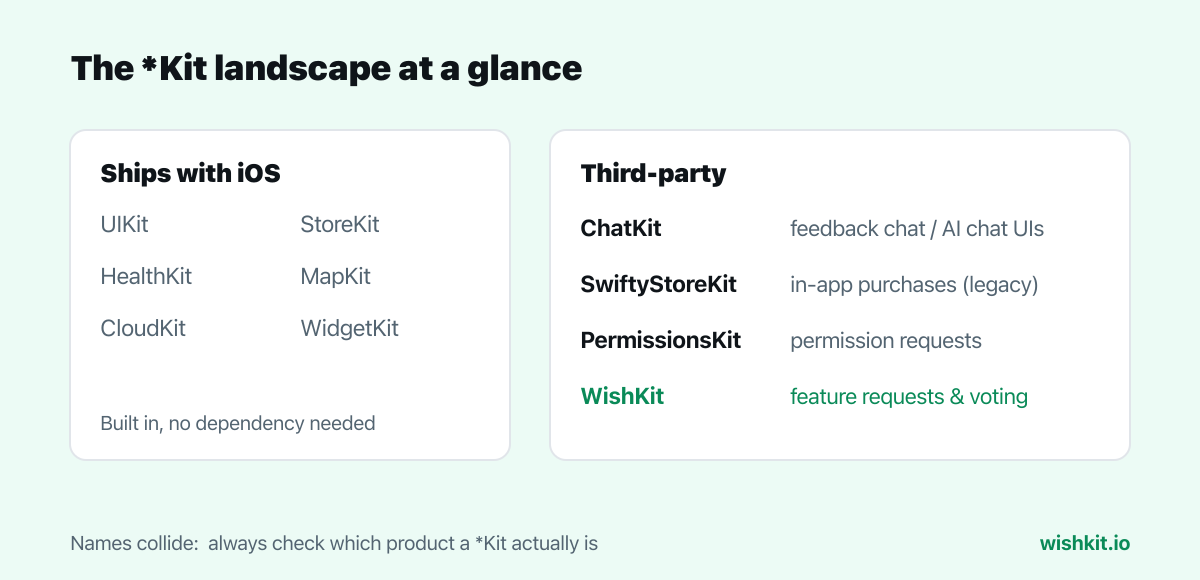
The suffix is so popular that most *Kit names mean several things at once. UIKit, StoreKit, HealthKit, MapKit, CloudKit, WidgetKit and friends are Apple's built-in frameworks and need no dependency at all. When you evaluate a third-party *Kit, first check whether Apple shipped the same capability natively, as with StoreKit 2 replacing most IAP wrappers. The best dependency is often the one you do not add.
A few third-party collisions you will run into: SwiftKit is at least three things, an MCP tool that teaches AI assistants iOS patterns, a SwiftUI boilerplate starter kit, and an older framework generator. HopeKit is a UI component library with themeable prebuilt views. ComponentKit is Meta's legacy Objective-C++ view framework from the pre-SwiftUI era, mostly of historical interest now. None of them relate to chat or feedback despite sitting next to those tools in search results.
Pick by maintenance, not by stars. An SDK that shipped its last release three years ago is a liability wearing a familiar name. Check the commit history, Swift version support, and whether the maintainer answers issues before you add anything to your app.
No. Two products share the name: OpenAI's web-first chat UI framework and trychatkit.com's in-app feedback chat SDK for iOS. Apple's similarly named frameworks (UIKit, StoreKit, and so on) ship with the OS.
It is in maintenance mode. For new projects Apple's StoreKit 2 is the default choice, with RevenueCat as the managed option for subscription-heavy apps.
PermissionsKit and SwiftyStoreKit are open source. ChatKit is free to use with OpenAI's platform. WishKit has a free plan, with Premium at $15 per month.
Setup takes less than a minute. Free plan included, no credit card required.
Try WishKit for free