Yes, we build a competing product. That is exactly why this review stays factual: what the Canny app does well, what it costs, and who should pick it.
By Martin Lasek · Aug 13, 2026 · Updated Sep 3, 2026 · 9 min read
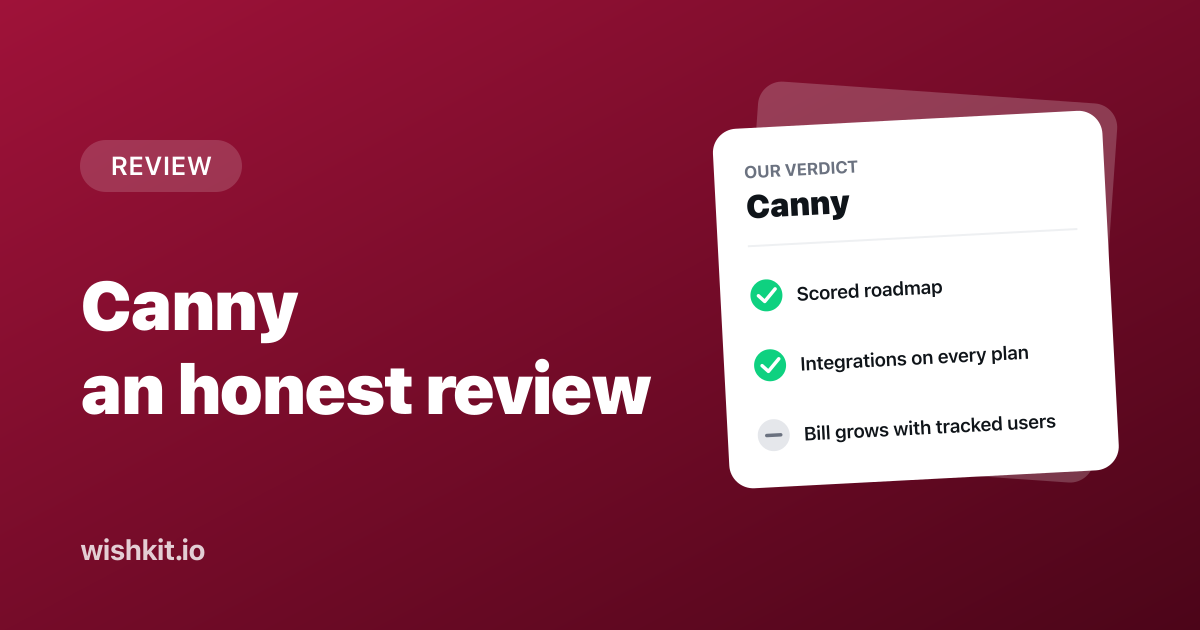
The short version. Canny is the most established feedback platform on the market: boards, roadmaps, changelog, the deepest integration ecosystem in the category, and AI features that mine feedback from your other tools. The trade-offs are a heavyweight onboarding and pricing that scales with how many of your customers leave feedback.
Canny (at canny.io) is a customer feedback management platform. Users post feature requests on public or private boards, vote, and comment. Your team triages requests, links them to a roadmap, and announces releases in a changelog. Around that core, Canny has grown an automation layer called Autopilot that deduplicates requests and extracts feedback from support tickets, sales calls, and community threads.
Canny has four product areas that work as one system: feedback boards, a roadmap, a changelog, and an AI layer called Autopilot, all connected to your other tools through integrations.
Three of those stand out against the rest of the market.
The integration ecosystem. Jira, Salesforce, Intercom, Zendesk, HubSpot, Slack, and dozens more, with mature two-way syncing. No competitor matches this depth, and for teams whose feedback lives across five tools it is the reason to pick Canny.
Autopilot. The AI layer that finds feedback in other channels and merges duplicates automatically. On high-volume products it does real triage work.
Maturity. Canny has been at this since 2017. Edge cases are handled, the roadmap features are deep, and enterprise requirements like SSO are covered.
Canny's AI is called Autopilot, and it is included on every plan, the free one too. It does four things.
Canny reports that in a Typeform test Autopilot identified feature requests with 93% accuracy and caught 30% more than the team had found manually. Take vendor numbers as vendor numbers, but the direction is right: on a product with real support volume, Autopilot does triage work a human used to do. Note that discovered feedback creates tracked users, so on Pro, turning Autopilot loose on your support inbox can move your bill.
The roadmap is where Canny is deepest. Requests carry a score you define, can be filtered by user segment, and can be sorted by the revenue of the customers who asked. You can publish a public roadmap with date estimates or keep an internal one, and both stay linked to the original posts so voters see progress without anyone updating two places.
The changelog is the closing half of the loop: write a release in markdown, attach images, schedule it, and Canny emails everyone who voted on the shipped requests. That email step is the part most teams actually want from a changelog, and it is also the one thing the free plan withholds. Free workspaces get the changelog page, but changelog emails to subscribers start on Pro.
Yes. The free plan includes boards, roadmap, changelog, integrations and Autopilot for up to 25 tracked users, enough to evaluate the workflow. The paid journey starts at $79 a month billed yearly.
Pro is $79 a month billed yearly ($99 monthly) for the first 100 tracked users, meaning customers whose feedback lives in the system, and climbs on a slider from there: roughly $129 at 200 users, $279 at 500, $529 at 1,000, and $1,079 at 5,000, with custom Business quotes beyond that. Canny retired its Starter and Growth plans in 2025. The full breakdown with example bills is in Canny pricing explained.
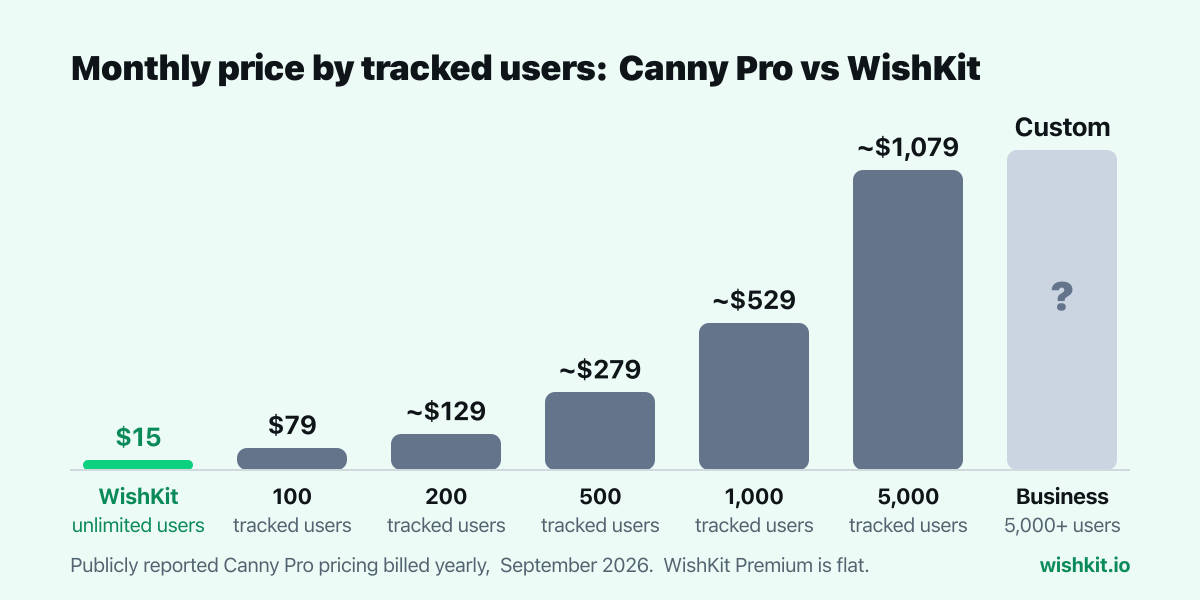
Success raises your bill. Tracked-user billing means the better your feedback program works, the more you pay. Model your user growth before committing.
Onboarding is a project. Canny itself acknowledges setup takes a while, and the dashboard has a steep learning curve. Budget real time for rollout.
No native mobile SDK. On iOS your users interact with Canny through web views, not native UI.
Yes, if two things are true: your feedback already lives in several tools, and you have enough support or sales volume for Autopilot to earn its keep. In that situation Canny replaces a spreadsheet, a tagging habit, and a weekly triage meeting, and the integrations mean product managers never leave Jira or Salesforce to see what customers asked for. Teams like that describe Canny as the tool that finally made feedback visible, and at Pro prices that is a good trade.
No, if what you need is a place where users post ideas and vote. Then you are paying tracked-user prices for a platform whose best features you will not turn on, and the onboarding alone costs more of your time than a focused board takes to set up. That is not a knock on Canny; it is built for the first group and priced accordingly.
Mid-size and larger product teams with a deep tool stack, meaningful support volume, and budget for a platform. For them Canny is a genuinely strong product and the integrations alone can justify it. Fair verdict: recommended at that scale.
If what you mainly want is users posting ideas and voting, the platform is more than the job needs, no matter how big your business is. We compared the field in the best Canny alternatives, and the direct head-to-head with our product is at WishKit vs Canny: free plan, flat $15/mo, native SwiftUI SDK, and setup in about 100 seconds.
There is a free plan for up to 25 tracked users. Paid plans start at $79 per month billed yearly and scale with tracked users.
Collecting feature requests and product feedback from customers in one place, letting them vote, deciding what to build with a scored roadmap, and announcing what shipped through a changelog. Its AI, Autopilot, also pulls feedback out of support and sales conversations automatically.
Yes. Canny has a REST API and Zapier support, and API access is available on every plan, including the free plan.
Scale and pricing model. Canny is a platform priced by tracked users. WishKit is a focused feedback board at a flat price with native SDKs for iOS, macOS, visionOS, watchOS and tvOS.
Setup takes less than a minute. Free plan included, no credit card required.
Try WishKit for free